
Robotic Process Automation: What It Delivered, Where It Stops, and How to Extend It
RPA has earned its place in most large organisations. It also has well understood limits, and those limits have left a large share of routine digital work untouched. This briefing sets out where RPA adds value, where it struggles, and how organisations can widen the scope of automation without replacing what already works.
What RPA is
Robotic process automation uses software to carry out tasks that people perform in business applications: logging in, reading fields, copying data between systems, filling in forms and following defined rules. A bot works through the same user interfaces a person uses, which means it can automate processes across systems that were never designed to talk to each other, without changing those systems.
Most enterprise programmes are built on one of a small number of established platforms and run through a centre of excellence. That team identifies candidate processes, builds and tests the automations, and manages them in production, often with the support of an implementation partner.
Where it is used
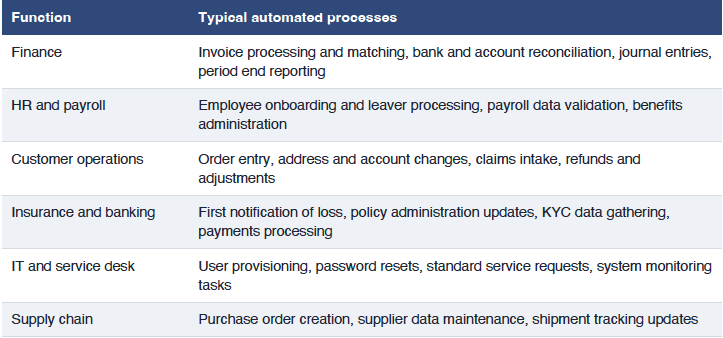
RPA is most effective where work is high in volume, rules based, stable and built on structured data. Those conditions are common in shared services and back office functions.
The value it has added
For the processes it suits, RPA has delivered measurable returns. EY reported that bots can reduce the cost of manual operations by roughly 25 to 40 percent without changes to underlying systems. In Deloitte’s 2019 global survey of 523 executives, organisations reported an average payback period of 15 months, falling to nine months for those that had reached scale.
The benefits go beyond cost:
Accuracy and consistency. Bots follow the same steps every time, which reduces rekeying errors and makes outcomes predictable.
Speed and availability. Work runs outside office hours and peaks are absorbed without overtime or temporary staff.
Auditability. Every action is logged, which supports compliance and internal audit.
Non-invasive change. Legacy systems can be connected without expensive integration or replacement projects.
A foundation for the future. Programmes have built governance, process discovery skills and a culture of automation that remain valuable whatever tools come next.
Where RPA reaches its limits
The same characteristics that make RPA effective on the right processes also define where it stops. Most programmes encounter the same set of constraints as they try to grow.
Programmes stall before scale. Deloitte’s 2019 survey found that 58 percent of organisations had started on automation, but only 8 percent had scaled beyond 50 automations. EY observed that as many as 30 to 50 percent of initial RPA projects fail.
Brittleness and maintenance. Bots depend on screen elements, selectors and fixed layouts. When an application is updated or a web portal changes, automations break and must be repaired. Maintenance becomes a growing share of the centre of excellence’s capacity as the estate expands.
A high threshold for viability. Each automation needs discovery, design, development, testing and ongoing support. That fixed cost has to be recovered through volume, so lower volume processes rarely make the business case.
Rules, not judgement. RPA struggles with unstructured inputs, variation between cases and decisions that a person makes from context. Process fragmentation was cited as the main barrier to scaling by 36 percent of organisations in Deloitte’s survey.
Difficult application types. Virtualised desktops, older thick client software and external portals are often unreliable targets, because bots must interact with them through images or coordinates rather than stable interface elements.
Specialist skills and central bottlenecks. Building automations requires trained developers. In the same survey, 59 percent of organisations piloting automation said they lacked the workforce capacity and skills they needed. Demand from the business usually exceeds what the centre of excellence can deliver.
How the frustrations show up
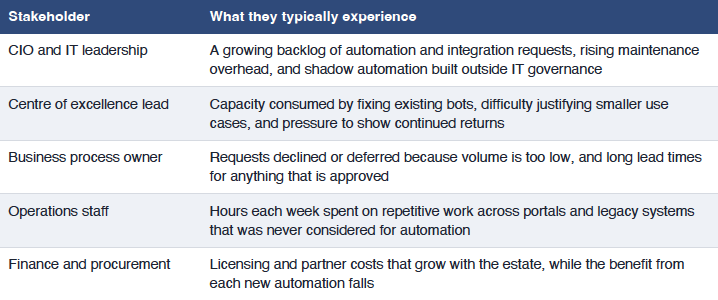
Each stakeholder experiences these limits differently. Recognising them is often the quickest way to locate the opportunity.
Extending the investment
None of these limits means RPA has failed. They describe the boundary of what it was designed to do economically. The opportunity is to extend automation beyond that boundary while keeping the existing estate where it performs well. Advances in AI make this practical. A newer generation of automation can interpret an application’s screen the way a person does, rather than depending on fixed selectors. Workflows can be captured by demonstrating or describing a task instead of being coded step by step. Together, these changes alter the economics in several ways:
Lower cost per workflow. When build effort falls from weeks to hours or days, tasks that run a few times a week become worth automating.
Resilience to change. Automations that read the screen each time are far less affected by interface updates, which reduces the maintenance burden.
Reach into difficult applications. Virtualised, legacy and external applications become realistic targets.
Tolerance of variation. Minor exceptions and differences between cases can be handled, with a person kept in the loop where judgement matters.
Wider participation. People who understand the work can help build and refine automations, with the centre of excellence setting standards and governance.
Flexible commercial models. Costs can be aligned with usage and outcomes, so the business can test and scale without large upfront commitments.
Where each approach fits
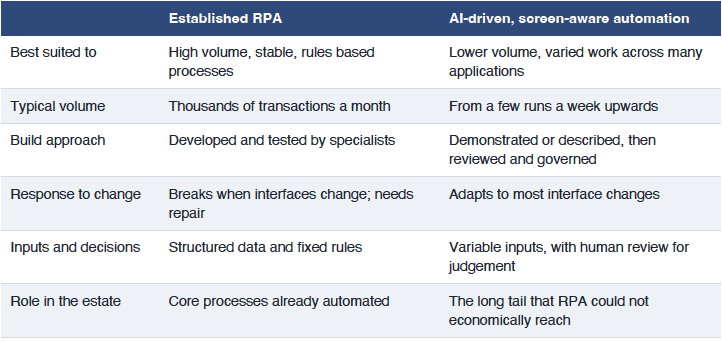
The two approaches are complementary. Most organisations will benefit from running both, with each applied to the work it handles best.
Questions to start with
Organisations looking to widen the scope of automation can begin by asking:
Which automation ideas have been rejected or deferred because the business case did not meet the threshold?
Which applications have been treated as off limits, and why?
How much of the centre of excellence’s capacity goes on maintaining existing bots rather than building new ones?
Where are teams building their own workarounds, such as macros, scripts or unsanctioned tools, outside IT governance?
What governance would be needed to let more people take part safely?
Which bots in the current estate break most often, and would they be cheaper to run another way?
The answers usually point to a substantial body of work that sits just beyond the reach of the current programme. That work can now be brought within scope at a cost that reflects its size, building on the investment and governance already in place.
Sources
Deloitte, Automation with intelligence: Reimagining the organisation in the ‘Age of With’, 2019 global survey of 523 executives. deloitte.com
EY, Get ready for robots: Why planning makes the difference between success and disappointment, 2016. ey.com
