
The API Desert: Why the "There's an App for That" Era Left Agents Stranded (Part 3/5)
The digital world feels interconnected, doesn't it? Every service seems to talk to another. You can link your calendar to your email, your CRM to your marketing platform, your accounting software to your banking. This illusion of seamless integration, fueled by the mantra "there's an app for that," has led many to assume that building AI agents would be a straightforward matter of chaining together APIs.
The reality, however, is far harsher: we're living in an "API Desert." For every shiny, well-documented API, there are dozens, if not hundreds, of critical business processes and legacy applications that remain stubbornly inaccessible to direct programmatic control. While the front-end user experience has exploded with diverse applications, the back-end connectivity needed for true agentic automation simply hasn't kept pace. This stark contrast between the visible surface of our digital tools and their hidden depths is one of the most significant contributors to the "agent gap."
When developers envision AI agents, they often picture a world where every action a human takes within an application has a corresponding API call. Need to extract data? There's an extract_data() endpoint. Need to click a button? There's a click_button() API. In a perfect world, this would be true.
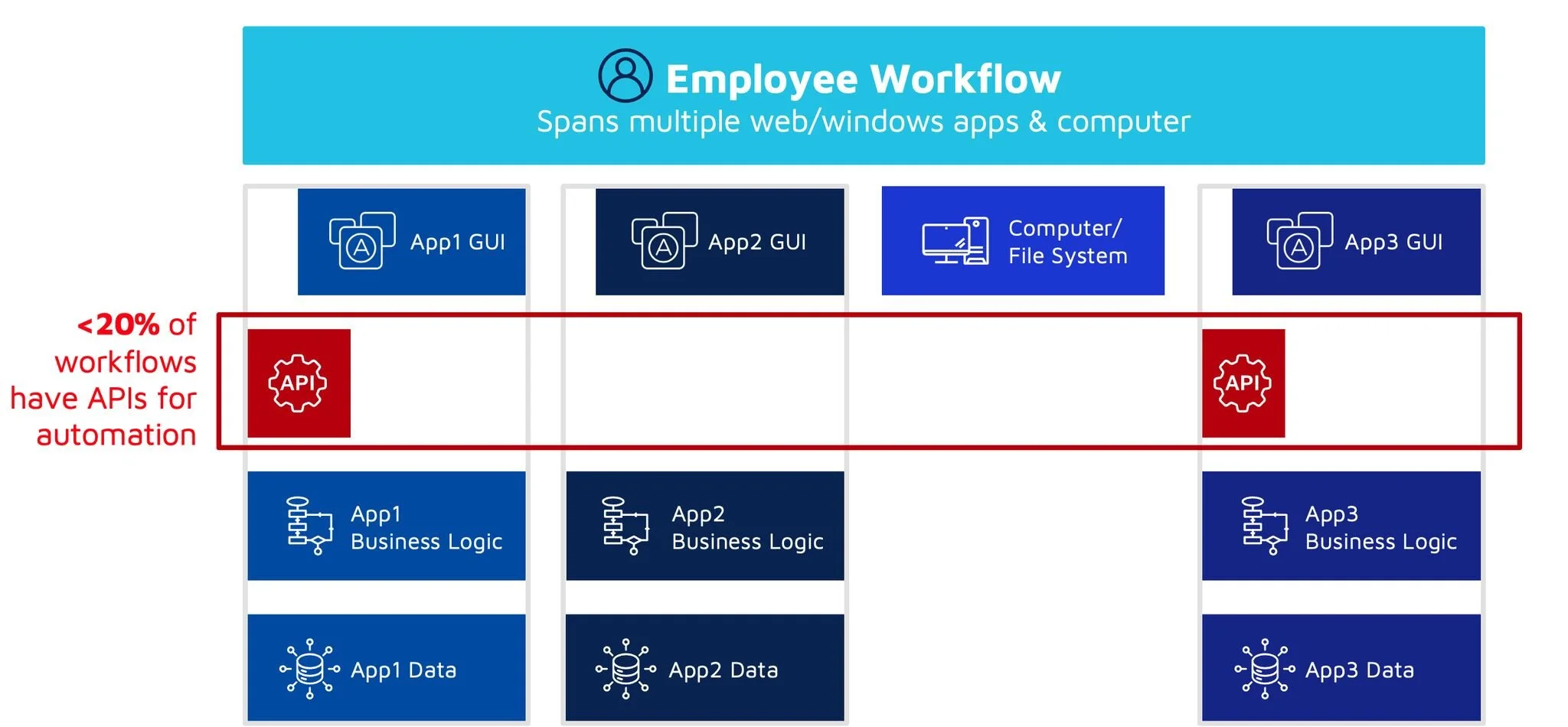
But our business environments are anything but perfect. They are Frankenstein monsters of:
- Legacy Desktop Applications: Built decades ago, before APIs were a widespread concept, these critical tools often lack any external programmatic interface. Their only "API" is the user interface itself—buttons, menus, text fields.
- Web Applications Without Public APIs: Many internal web tools or niche SaaS products are designed for human interaction only, with no exposed APIs for external integration. Even if they have private APIs, they aren't accessible without deep internal knowledge or explicit permission.
- Proprietary Systems: Financial services, manufacturing, healthcare—industries often rely on highly specialized, proprietary software with closed architectures that resist external automation.
- Unstructured Data Sources: A significant portion of business information resides in PDFs, scanned documents, images, and email bodies, which are not amenable to simple API calls.
For many vital workflows, the graphical user interface (GUI) isn't just one way to interact; it's the only way. A human can navigate a complex set of nested menus in an old Windows application, copy text from a scanned document, or click through a series of web pages to complete a task. For an AI agent, this presents an enormous challenge.