
The "One-App" Trap: Why an Agent Trapped in a Single Application Has Limitations (Part 2/5)
Imagine a personal assistant who can only operate within the confines of a single room. They can expertly organize that one room, but if a task requires stepping into the hallway, opening a closet, or fetching something from another office, they freeze. They aren’t truly an assistant.
This is the fundamental flaw in much of the current AI "agent" conversation: the "One-App Trap." We’re promised intelligent automation that will revolutionize our workflows, yet most of the demos and solutions are confined to a single application—a CRM, a chat platform, or a specific web service. While useful within their narrow scope, these are not the game-changing agents that will truly automate human work.
True productivity, the kind that saves us hours, rarely happens in a silo. It jumps from email to spreadsheet, from web browser to legacy desktop application, from local file system to cloud storage. And until our AI agents can make that same leap, the "agent gap" will remain a chasm.
A human seamlessly transitions between these disparate tools. An "agent" designed only for Outlook, Excel, or a specific web app, is rendered functionally blind and useless outside its digital cage.
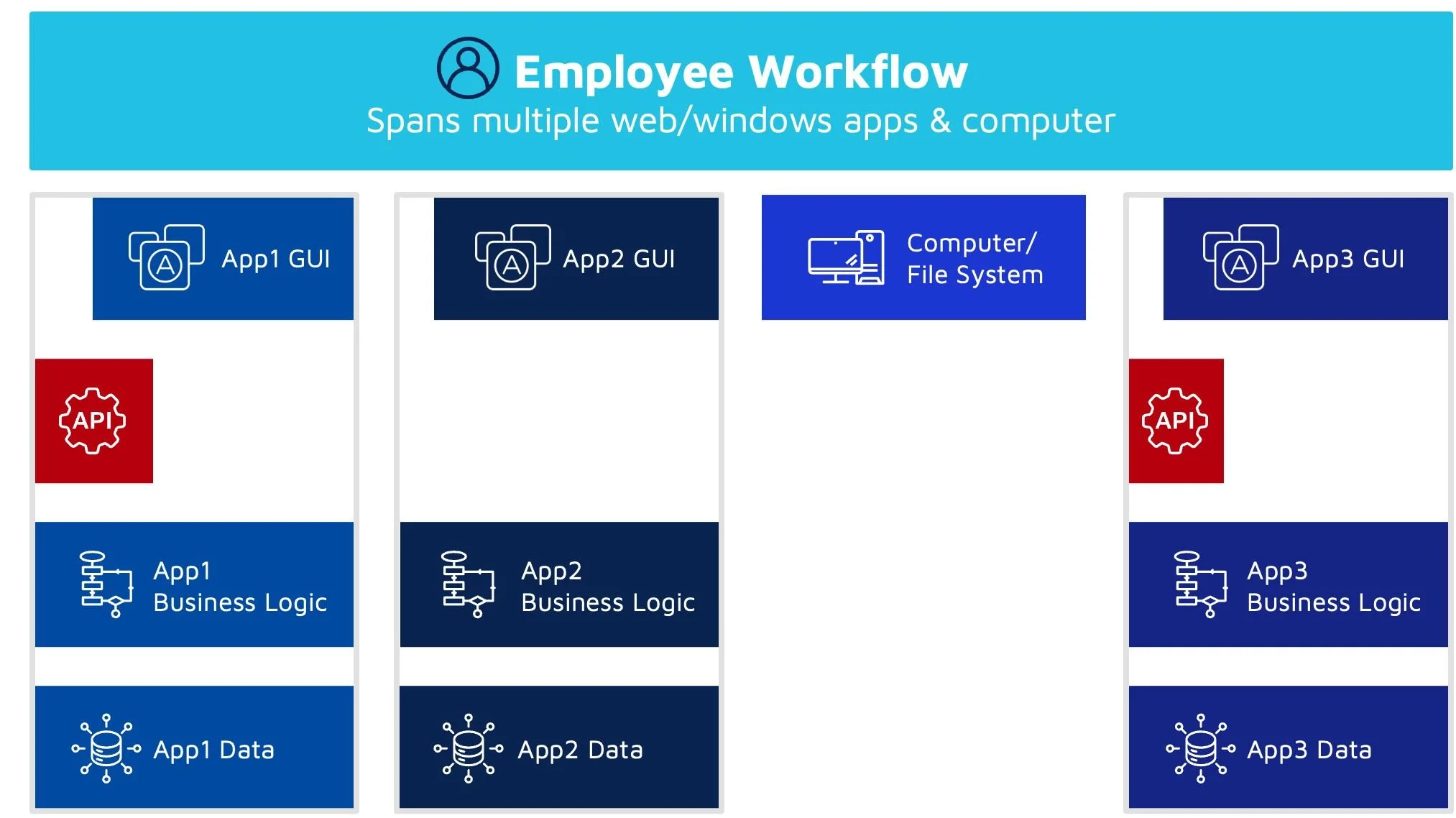
The agents we truly need are "cross-app." They must have the ability to Navigate Diverse Graphical User Interfaces (GUI):
- Interact with web forms, desktop application menus, file system dialogs, and command-line interfaces with equal fluency.
- Execute Complex Sequences: String together actions across multiple applications in a logical, goal-oriented manner, adapting to changes and making decisions along the way.
- Handle Unstructured Data: Extract information not just from structured databases, but from documents, images, and free-form text found anywhere on the system.